



Why Your Home Still Feels Humid Even When the AC Is Running
Air conditioning does two things: it lowers temperature and it removes moisture from the air. When your system is running but your home still feels sticky and uncomfortable, the moisture removal side of that equation is failing. Understanding why helps you fix the right thing instead of chasing a problem in the wrong direction.
This is a particularly common complaint in central Pennsylvania. York, Lebanon, Lancaster, and Dauphin Counties sit in a mid-Atlantic climate zone where summer relative humidity regularly exceeds 70 to 80 percent. An AC system that cannot manage that moisture load leaves homeowners uncomfortable even when the thermometer reads a reasonable temperature.
How AC Systems Remove Humidity
When warm, humid air passes over the cold evaporator coil inside your air handler, the coil surface temperature is below the dew point of the air. Moisture in the air condenses on the coil surface, much like water collects on a cold glass of water on a humid day. That condensate drains into the drain pan and out through the condensate line.
For this process to work effectively, the air needs to stay in contact with the cold coil long enough to give up its moisture. This is where run time matters. Longer, lower-intensity cooling cycles remove significantly more moisture than short, intense bursts.
Reason 1: Oversized AC System
An oversized AC system is the single most common cause of poor humidity control in central Pennsylvania homes. It is also the most frequently overlooked, because homeowners assume bigger is better when it comes to cooling.
Here is the problem: an oversized system reaches the thermostat’s temperature setpoint very quickly, then cycles off. That rapid cooling cycle does not give the evaporator coil enough time in contact with humid air to remove meaningful amounts of moisture before the system shuts down.
The result is a home that feels cool when the system first kicks on, but becomes sticky and uncomfortable within minutes of shutdown, prompting the system to cycle on again in a short, ineffective burst. This pattern repeats throughout the day without ever effectively wringing moisture out of the air.
The Air Conditioning Contractors of America (ACCA) publishes Manual J, the industry-standard load calculation method that determines the correct equipment size for each home. A system sized using Manual J will have run times long enough to control both temperature and humidity.
Reason 2: Dirty Evaporator Coil
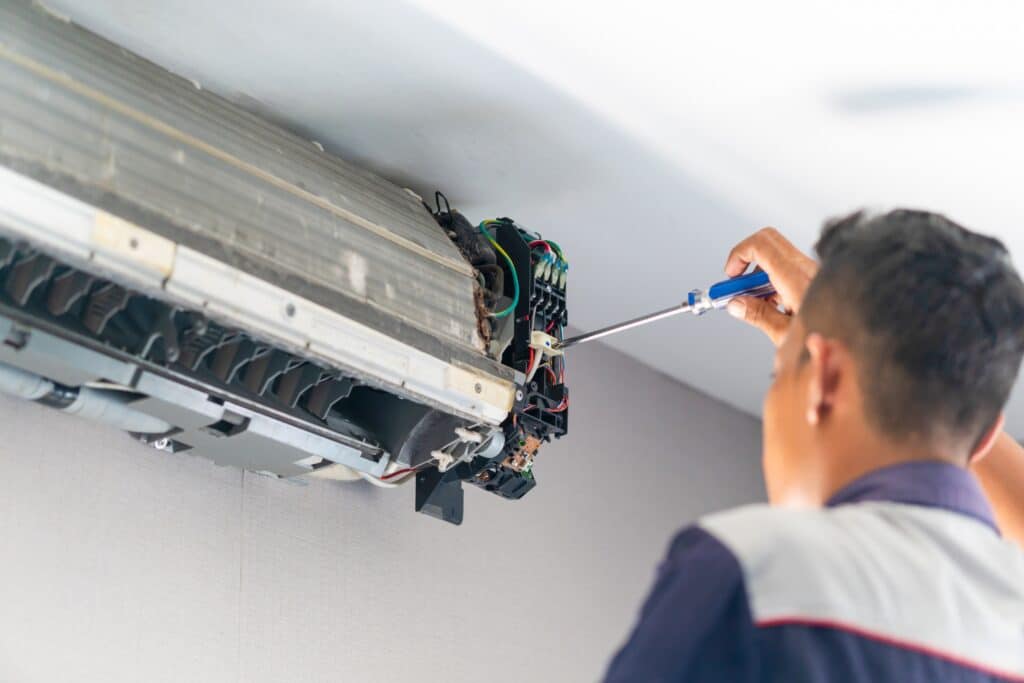
A coil coated with dust and grime cannot transfer heat, or extract moisture, as efficiently as a clean one. When the coil surface is insulated by a layer of debris, the condensation process is compromised. Less moisture condenses per cycle, and the excess stays in your indoor air.
Annual coil cleaning is one of the most impactful maintenance tasks for humidity control. The ASHRAE Handbook of HVAC Applications documents that fouled coils can reduce system capacity and efficiency by 10 to 30 percent, with humidity removal affected proportionally.
Reason 3: Low Refrigerant
When refrigerant charge drops below the correct level, the evaporator coil operates at a higher temperature than it should. A warmer coil surface means less condensation, which means less moisture removed from the air. The system may still produce some cooling, but its dehumidification performance drops sharply.
Refrigerant loss always indicates a leak. A system that has been “topped off” repeatedly without the leak being repaired will continue to degrade in humidity performance each season.
Reason 4: The System Is Running Too Short or on Fan-Only Mode
Two easy-to-overlook causes of indoor humidity are the fan setting and thermostat mode. If your thermostat fan setting is set to “On” instead of “Auto,” the blower runs continuously even when the compressor is off. During the off cycle, the moisture that condensed on the evaporator coil can re-evaporate into the airstream and be blown back into the home.
The fan should be set to “Auto” for normal operation, which means the blower only runs when the compressor is actively cooling. This allows condensate to drain before the next cycle begins rather than re-entering the air supply.
Reason 5: Ductwork Leaks Pulling in Unconditioned Air
In homes where supply or return ducts pass through unconditioned spaces like attics or crawlspaces, duct leaks draw in hot, humid air from those spaces and mix it with the conditioned air before it reaches living areas. The system is cooling and dehumidifying air that is then diluted with humid attic air before it gets to you.
The U.S. Department of Energy estimates that duct leakage accounts for more than 30 percent of HVAC energy loss in a typical home. Homes with significant duct leakage in humid climates experience both higher energy bills and persistent indoor humidity problems.
Reason 6: The Home Has High Moisture Sources
Sometimes the AC system is functioning correctly but is overwhelmed by indoor moisture sources it was not sized to handle. Common culprits include:
-
Cooking without adequate range hood exhaust
-
Long or frequent showers with insufficient bathroom ventilation
-
Basement or crawlspace moisture migration through the slab or walls
-
Houseplants in large quantities
-
A clothes dryer not vented to the exterior
Before concluding the AC is the problem, assess whether any of these sources have changed, particularly if the humidity issue is new in a home where the system was managing fine in previous summers.
Pennsylvania-Specific Context: Why This Is More Common Here
Central Pennsylvania’s mid-Atlantic climate creates a combination of conditions that make humidity control particularly demanding. The National Weather Service data for the York-Harrisburg metro shows average July relative humidity of around 70 percent in the afternoon, rising to 85 to 90 percent overnight.
Homes that were cooled adequately in drier regions of the country, or older homes with AC systems originally selected for temperature control rather than humidity management, often struggle to maintain comfortable indoor humidity without a properly sized and maintained system.
Variable-speed AC systems, which adjust compressor output to match the actual load rather than simply cycling on and off at full capacity, are particularly effective at humidity control in climates like central Pennsylvania’s. A low-speed, long-duration cycle removes significantly more moisture than a series of short high-speed cycles for the same total cooling delivered.
What Homeowners Can Do Right Now
-
Switch the thermostat fan setting from “On” to “Auto.”
-
Replace the air filter if it has not been changed recently.
-
Inspect the outdoor unit and make sure airflow around it is not restricted.
-
Check that the condensate drain line is not clogged (a backup causes water to overflow rather than drain away, keeping the coil wet and reducing dehumidification).
-
Address any obvious indoor moisture sources.
When the Problem Requires a Professional
If the steps above do not resolve the issue, the cause is likely refrigerant loss, a dirty coil, an oversized system, or ductwork leakage, all of which require a licensed HVAC technician with the correct equipment to diagnose and address properly.
JX Pro Heating and Cooling has served York, Lebanon, and surrounding Pennsylvania communities for over 15 years. As a licensed HVAC contractor (License PA203730) and certified Rheem Pro Dealer, our technicians diagnose humidity and cooling performance problems accurately and give you a clear plan before any work begins.
Our AC maintenance service includes coil cleaning, refrigerant check, condensate drain inspection, and a full system performance evaluation. For homeowners whose system was not properly sized, we can assess and recommend energy-efficient AC upgrades including variable-speed systems that excel at humidity control. Our central AC service covers the full scope of what your system needs to manage both temperature and moisture effectively.
Call JX Pro Heating and Cooling at 717-600-4220 to schedule a diagnostic visit. We serve York, Lebanon, Lancaster, Harrisburg, Hershey, and surrounding communities throughout central Pennsylvania.